
The whole sexist point of view.
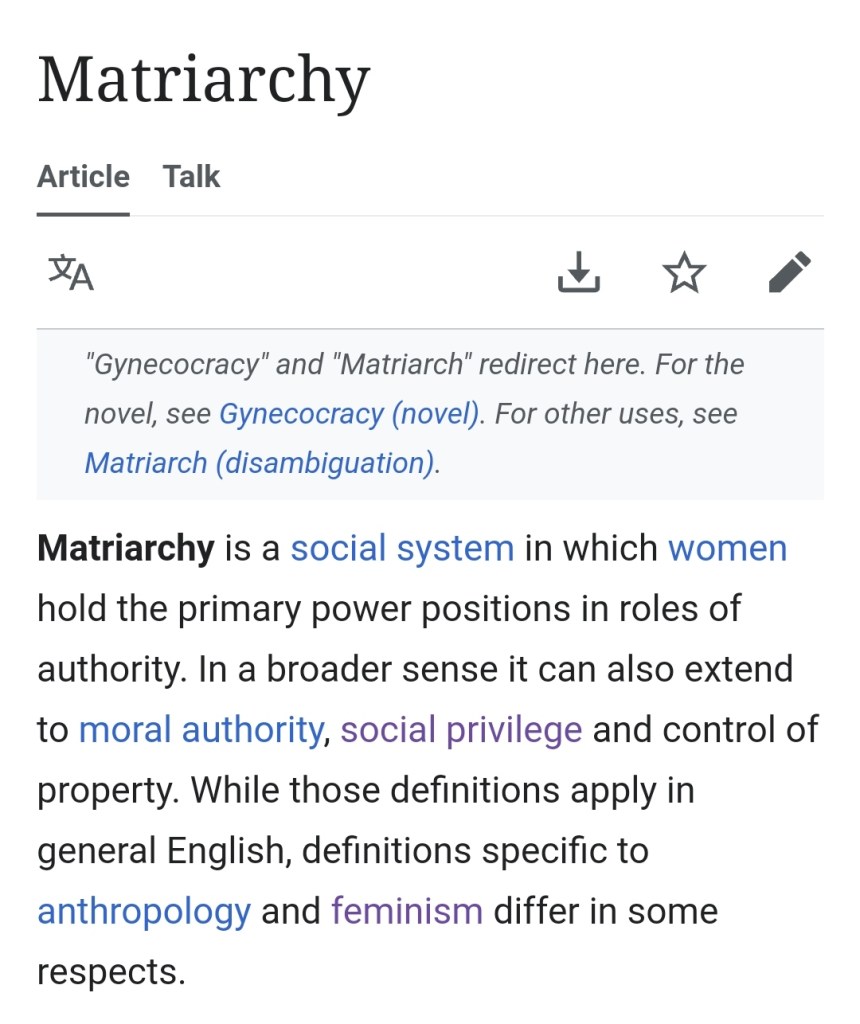
Matriarchy is a social system in which women hold the primary power and predominate in roles of political leadership, moral authority, and social privilege. A matriarchal system is typically centered around the family, with the mother as the head of the household and the father taking a subordinate role. (ao)
“Not a shred of evidence supports the existence of matriarchy anywhere in the world at any time… The matriarchy hypothesis, revived by American feminism, continues to flourish outside the university.”
Camille Paglia
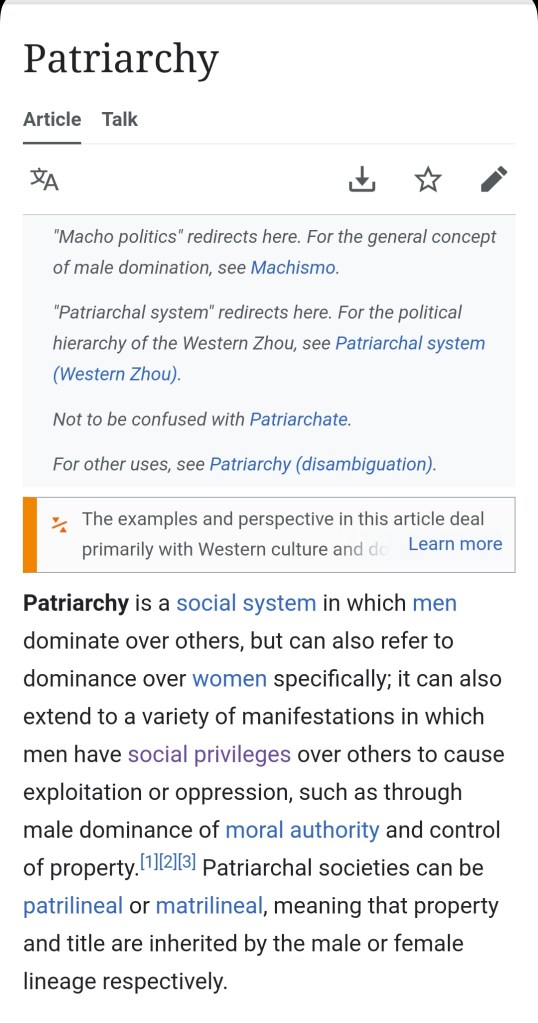
Patriarchy is a social system in which men hold the primary power and predominate in roles of political leadership, moral authority, and social privilege. A patriarchal system is typically centered around the family, with the father as the head of the household and the mother taking a subordinate role. (ao)
AI Created: Artificial Intelligence talking about Usury.
Me: Usury plus usury unawareness will create episodes of: “Matriarchy vs Patriarchy”.
ChatGPT (jan23):
It is possible that in a society influenced by usury and usury unawareness, there may be a shift in the balance of power between matriarchal and patriarchal systems, as individuals and groups compete for resources and financial stability. This could lead to tension and conflicts between different groups, as well as a re-evaluation of traditional gender roles and expectations. However, it is important to note that the relationship between usury and societal power dynamics is complex and multifaceted, and can not be reduced to a simple cause and effect relationship.
Me: For something (usury and usury unawareness) that influences so many things it is hardly discussed. Why? Who would benefit not to discuss this?
ChatGPT:
Usury, which is the practice of charging excessive or illegal interest on loans, has been a controversial topic for centuries. It is often seen as a form of financial exploitation, particularly for vulnerable or marginalized groups. The reason it is not discussed more widely could be due to a lack of education or awareness about the issue, as well as a lack of political will to address it. Additionally, those who benefit from usury, such as banks and financial institutions, may have a vested interest in keeping the conversation around usury to a minimum.
Me: What kinda person is someone who eagerly wants the world to know about usury and usury unawareness?
ChatGPT:
Someone who is aware of the negative effects of usury and usury unawareness on society and wants to raise awareness and educate others about the issue in order to bring about change and create a fairer, more just financial system. This person may be a social activist, a financial expert, or someone who has personally been affected by usury and wants to prevent others from experiencing the same negative consequences.
Me: Now answer me that same question as Nietzsche.
ChatGPT:
As Nietzsche would put it, someone who eagerly wants the world to know about usury and usury unawareness is a “free spirit” – a person who is unafraid to question and challenge the dominant beliefs and values of their society. They possess a strong sense of individualism and independence, and are driven by a desire to uncover and expose the truth, even if it is uncomfortable or unpopular. They are also likely to possess a strong sense of morality, and may be deeply concerned about the negative impact of usury on individuals and society as a whole.
Me: Now answer me that same question as Kant.
ChatGPT:
As a follower of Immanuel Kant, one would likely argue that the desire to bring awareness to the issue of usury and usury unawareness stems from a sense of moral duty. Kant believed in the categorical imperative, the idea that one should always act in such a way that one could will the maxim of one’s action to become a universal law. In this case, the desire to raise awareness about usury and its negative effects on society would stem from the belief that it is morally right to do so, and that this belief should be universalized. Thus, one who eagerly wants the world to know about usury and usury unawareness would be someone who is guided by a sense of moral duty and the desire to make the world a better place.
Me: Now answer me that same question as Jung.
ChatGPT (jan23):
As Jung, one might say that an individual who eagerly wants the world to know about usury and usury unawareness is someone who is on a path of individuation, striving to integrate the shadow aspects of society and bring them to consciousness. This person may be driven by a desire for personal and collective healing, as well as a sense of social responsibility and a desire for true justice and equality.
It should be noted that the views of historical figures like Nietzsche, Kant and Jung on Usury and Usury unawareness may not be directly available as they may not have written or spoken about these specific topics and the answer provided is based on their general philosophy and ideas.
Buy the AI a drink (in holofuel)
Extra:
Matriarchy and patriarchy have many similarities. Both systems involve the power and privilege of a certain group over another. Both are based on the idea of gender roles and norms, with one gender being seen as superior to the other. However, the main difference between the two is the gender that holds the power and privilege. In a matriarchal system, women are in power and hold the majority of privileges, while in a patriarchal system, men are in power and hold the majority of privileges. (ao)
Wikipedia:
Affiliate:
Books:
- “The Chalice and the Blade” by Riane Eisler
- “Women, Race, and Class” by Angela Davis
- “The Second Sex” by Simone de Beauvoir
- “The Handmaid’s Tale” by Margaret Atwood
- “Sister Outsider” by Audre Lorde
Documentaries:
- “The Ascent of Woman” (2015)
- “Half the Sky: Turning Oppression into Opportunity for Women Worldwide” (2012)
- “She’s Beautiful When She’s Angry” (2014)
- “Miss Representation” (2011)
- “The Mask You Live In” (2015)
Movies:
- “The Color Purple” (1985)
- “Thelma & Louise” (1991)
- “The Help” (2011)
- “Hidden Figures” (2016)
- “Mulholland Drive” (2001)
Series:
- “The Handmaid’s Tale” (2017-2022)
- “Big Little Lies” (2017-2019)
- “Orphan Black” (2013-2017)
- “Jessica Jones” (2015-2019)
- “The Crown” (2016-2022)
Songs:
- “Bitch” by Meredith Brooks
- “Respect” by Aretha Franklin
- “Man! I Feel Like a Woman!” by Shania Twain
- “Sisters Are Doin’ It for Themselves” by Eurythmics and Aretha Franklin
- “Formation” by Beyoncé
Artworks:
- “The Dinner Party” by Judy Chicago
- “Goddess of the Waters” by Francheskaa
- “Redstockings Manifesto” by the Redstockings
- “Untitled (Your Body Is a Battleground)” by Barbara Kruger
- “Guerrilla Girls” posters and art installations
Podcasts:
- “The Guilty Feminist”
- “Code Switch”
- “Femme Wonk”
- “Sisterhood Is Global Institute”
- “The Waves” by Slate Magazine.
Purpose: to see what’s in common
Would you agree…
#Usury #UsuryC #UC072 #UC073 #UC074
 Usury
Usury 
Leave a comment